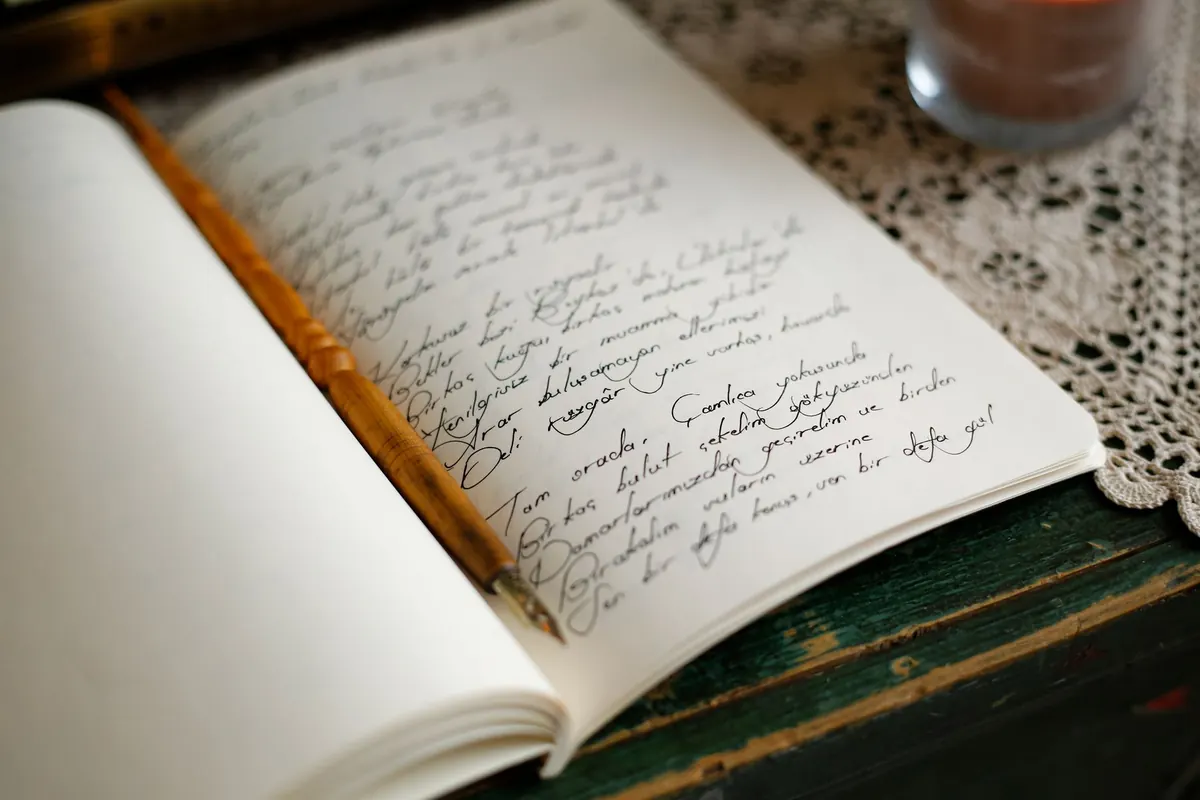
Most notebooks fill up and then sit unread on a shelf. A commonplace book is built to be reopened. Readers have kept them for centuries as a single place to gather lines worth remembering, half-formed observations and arguments worth arguing with. John Locke even published a method for indexing one. The purpose was never to record a life. It was to build a stock of raw material for thinking, and to keep that material where you can find it again.
What a commonplace book is, and what it is not
It is not a diary. Nothing needs a date, and nothing needs to follow on from what came before. It is not a journal either, in the sense of tracking mood or progress. A commonplace book is closer to a workshop shelf: a collection of parts you liked the look of, kept because they might fit something later.
The distinction matters because it changes what you write down. A diary entry describes an event. A commonplace entry captures a fragment that caught your attention for reasons you may not yet understand.
What to put in it
Anything that made you pause. In practice, most entries fall into a handful of types:
- Lines from reading. A sentence from a novel, an essay, a manual, a report. One sentence, not the whole page.
- Overheard speech. The way a stranger described the weather, a phrase a child used, a line from a bus conversation.
- Observations of how things work. How a bakery queues customers, how a shop arranges its stock, how a colleague runs a meeting.
- Questions you cannot answer yet. Write them down unresolved.
- Practical scraps. A recipe ratio, a way of folding card, a route through a city.
- Claims you disagree with, written out fairly rather than as a straw man.
- Shapes and patterns. The structure of a story you admired, a colour combination, a design that worked.
Always note where an entry came from, even roughly. The source is often the thing that makes a fragment usable later, because context is what turns a nice line into an argument.
Keep the capture cheap
Friction is what kills this habit. A notebook you have to hunt for is a notebook you will not use. Choose whatever is always within reach: a pocket notebook, a notes app, a stack of index cards by the kettle. Keep one, not five.
Two rules make the rest easier. First, write the fragment down while it is still live in your mind; do not save it for a tidy page later. Second, do not judge it at the moment of capture. Deciding whether something is useful is a separate job, and doing it too early means losing things you would have grown into.
Paper or digital?
Both work. Paper encourages brevity and forces you to handle the words as you write them. Digital is searchable, but tends to become a graveyard of clipped articles nobody reopens. A reasonable compromise is to capture on paper and transfer anything that still interests you after a week.
Give yourself a way back in
A collection you cannot search is just clutter. Before the book is full, decide how you will find things:
- Number the pages as you go, or use a notebook that arrives numbered.
- Assign one or two headings to each entry. Keep the list short and reuse it: attention, habits, light, beginnings, persuasion.
- Build an index at the back. Add entries to it as you fill pages, not at the end.
- Use simple marks for entry types, so a quotation is distinguishable from a question at a glance.
Locke's approach is worth borrowing in spirit: he indexed by the first letter of a heading word followed by its next vowel, so page numbers could be slotted into a grid without renumbering everything. You do not need the grid. You do need some version of the principle, which is that retrieval should take seconds, not minutes.
The step most people skip: rereading
Collecting is not thinking. The value appears when you go back. Set aside twenty minutes a fortnight, or a full hour once a month, and read your own entries with a pen in hand.
Read for three things: patterns that recur, entries that contradict each other, and questions you have asked more than once. Mark anything you had forgotten, because forgetting and rediscovering is often where the surprise lives.
A commonplace book is not a record of what you have read. It is a stock of material for whatever you might make next.
Turning fragments into ideas
When you want to generate something rather than store it, try one of these:
- Forced pairing. Open the book twice at random and write a paragraph connecting the two entries. Most pairings fail. The occasional one will not.
- Expansion. Take a single line and write 150 words around it, keeping the original visible.
- Answer a question. Pick something you could not answer and draft a response you do not fully believe, just to see where it goes.
- Follow a thread. Gather five entries under a new heading. A heading that survives this test is usually an idea for a piece of work.
- Flip an argument. Take a claim you agree with and write the strongest case against it.
Not every session produces anything. That is normal, and it is not a sign the practice is failing. The collisions matter more than the hit rate.
Mistakes that make it stall
Copying too much is the most common one; take the sentence that stopped you, not the surrounding essay. Chasing neatness runs a close second, followed by filing entries under book titles instead of themes, which makes them almost impossible to recombine. Writing for an imagined reader is another quiet killer, because it makes you censor the odd, specific things that turn out to be useful. And treating the whole thing as a performance, rather than a working shelf, removes the only real benefit it has.
Start with ten entries
This week, aim for ten entries. Not ten pages, and not ten profound thoughts. Single lines are fine. Add a source when you have one, number the pages so you can index later, and resist the urge to tidy anything.
At the end of the week, read the ten back and write one sentence at the bottom of the last page about what they have in common. Repeat the following week. Within a month you will have something no app quite provides: a working map of what you actually notice, and a supply of raw material for the next thing you want to make.
Photo: betül nur akyürek / Pexels