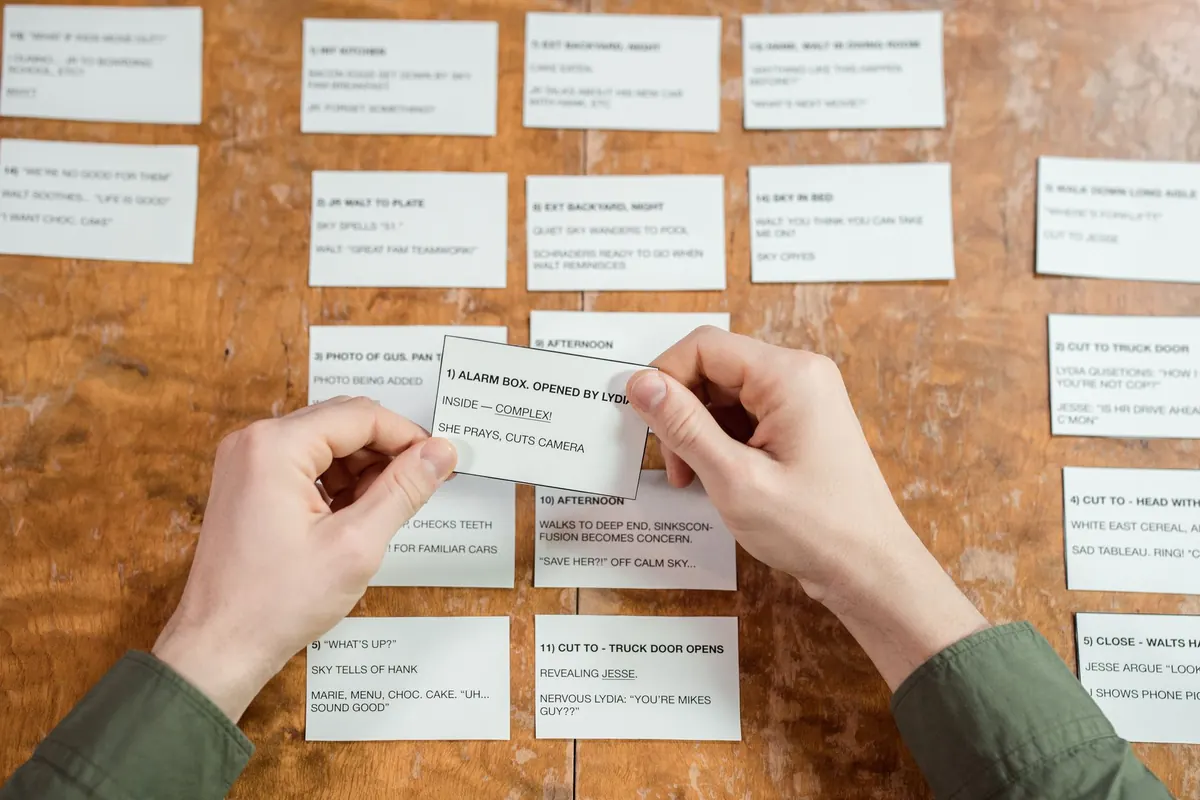
Most note-taking systems store information and stop there. You read something useful, write it down neatly, file it away — and six months later you cannot remember it exists, let alone why it mattered. The Zettelkasten method works differently. Instead of a filing cabinet, you build a network of small notes that link to one another, so ideas resurface when they are relevant. The idea is simple. The discipline is in the details.
What a Zettelkasten actually is
Zettelkasten is German for "slip-box". The name comes from the sociologist Niklas Luhmann, who kept a box of index cards for decades — tens of thousands of them — and drew on it constantly in his writing. What made it work was not the box. It was three habits.
Each note holds a single idea. Each note is written in your own words. And each note connects to other notes, so the collection behaves less like an archive and more like a conversation.
That is the whole method. Numbering systems, index cards, folders and software are implementation details. A Zettelkasten is not a diary, a to-do list, or a place to dump quotes. It is a place to think.
Atomic notes: one idea per note
The single most useful rule is atomicity: one note, one idea. If you cannot express the point in a sentence, it is probably two notes wearing one hat.
Compare these two titles:
- "Memory — chapter 3"
- "Recalling something from memory strengthens it more than reading it again"
The first is a label. The second is a claim you can agree with, argue against, or connect to something else. Only the second is worth linking to.
Under the title, write a short paragraph in your own words. Not a copied passage, not a highlight — your explanation, as if you were telling a colleague about it next week. If you cannot paraphrase an idea, you have not finished reading it yet. Three to five sentences is usually enough. Long notes bury their own point.
Atomicity also pays off later, when your interests shift. A note called "Memory" becomes dead weight the moment you stop caring about memory. A note called "Recalling something strengthens it more than rereading" can be linked to a note about teaching, one about sales training, and one about why your child's spelling drills are not working. Small claims travel. Big containers do not.
Linking is where the value lives
A box of unlinked notes is just a stack of paper. Links turn it into a thinking tool, because they record not only what you know but how one thing bears on another.
When you finish a note, ask a few questions:
- What does this remind me of?
- What does it support or strengthen?
- What does it contradict?
- Where have I seen this pattern before?
Then write the link as a sentence, not just a reference. Something like:
This sits awkwardly next to my note on deliberate practice. Both assume attention is a scarce resource, but they disagree about whether it should be spent on weaknesses or on strengths.
That sentence is worth more than the two notes it joins, because it contains your thinking. And if your tool supports backlinks, the connection shows up from both directions, so an old note can surprise you months later.
Notice what is missing: fixed categories. There is no "Psychology" folder with a "Memory" subfolder. Structure emerges from the links themselves, which is why a slip-box tends to grow in directions you did not plan.
Paper or digital?
Both work. The right answer is whichever one you will actually open on a Tuesday evening.
The paper slip-box
Use index cards — A6 is a pleasant size — and one box. Give each card a number. Cards on a related theme sit near each other, with branches numbered 1a, 1b, 1a1 and so on. Keep a small alphabetical index of key terms pointing to card numbers, and write links directly on the cards.
Writing by hand slows you down, which helps when the goal is understanding rather than capture. You can spread cards across a table and see the shape of an argument. The trade-off is search, and you will lose the odd card.
The digital slip-box
Any note app with fast search and links between notes will do, and a folder of plain text files works just as well. Keep titles as full sentences, since the title is how you will find and link the note later. Use a handful of broad tags rather than dozens of narrow ones, and resist deep folder hierarchies — links do that job better.
Digital wins on search and backup. It loses some of the friction that forces you to think, so if you type quickly, impose a rule on yourself: no new note without at least one link to an existing note. That single constraint restores most of the thinking the keyboard takes away. If you want a middle path, write notes by hand and keep an index of them digitally — clumsy, but it keeps the slow, deliberate part of the habit intact.
The step beginners skip: literature notes
Most people jump straight from reading to permanent notes and end up copying sentences out of a book. Luhmann avoided this by keeping a separate set of literature notes: brief jottings made while reading, each with a page reference and just enough context to find the passage again. These are working notes. They are not the slip-box itself, and they are not meant to be permanent.
The sequence is short. Read with a pen in hand and take literature notes as you go. Wait a day. Then, with the book closed, write permanent notes from those jottings in your own words, one idea each, linking as you write. Once a source has been fully processed, the literature notes have done their job and can be archived.
That gap between reading and writing matters more than it sounds. It is the point where you discover you only half understood something — which is exactly the discovery you want to make while the book is still open.
A first-week workflow
If you want to start today, keep it small. One note a day for a week beats a grand system you abandon by Friday.
- Read something short — an article, a chapter, twenty minutes of a talk.
- Jot three or four literature notes with page or timestamp references.
- Wait until the next day, then write one permanent note per idea, in your own words, with a sentence for a title.
- Open your existing notes and find two to link to. Write the link as a sentence explaining the relationship.
- Add a one-line entry to your index if the idea deserves a new entry point.
- Close the app or the box. Do not reorganise anything.
Six steps, maybe twenty minutes. After a month you will have thirty or forty linked notes and the first hints of structure. After a year you will have something no highlighting app can give you: a map of what you actually think.
Common mistakes worth avoiding
- Collecting instead of writing. Saved articles and highlights are not notes. If it is not in your own words, it is not in your slip-box.
- Notes that are too long. A page-long note is a document, not an idea. Split it.
- Tags as a substitute for links. Tags group things; links explain them. You need explanations.
- Perfecting the system. Rearranging folders feels like work and produces nothing. The notes are the work.
- Waiting for a big idea. Small, plain observations link beautifully a year later. Most of your best notes will start out unremarkable.
Why it is worth the effort
The Zettelkasten method asks more of you than a highlighting app does, and that is the point. You cannot paraphrase an idea you have not understood, and you cannot link it to something else without knowing what it means. Every note is a small test you either pass or notice yourself failing.
The payoff arrives late. Some evening you will be writing about something unrelated, follow a link out of habit, and find that you argued the other half of the point two years ago, in your own handwriting, and forgot. That is not a filing system doing its job. That is a thinking partner.
Start with one note. Make it one idea, in your own words, and link it to something. The rest is repetition.
Photo: Ron Lach / Pexels